What's new
USCHO Fan Forum

This is a sample guest message. Register a free account today to become a member! Once signed in, you'll be able to participate on this site by adding your own topics and posts, as well as connect with other members through your own private inbox!

  • The USCHO Fan Forum has migrated to a new plaform, xenForo. Most of the function of the forum should work in familiar ways. Please note that you can switch between light and dark modes by clicking on the gear icon in the upper right of the main menu bar. We are hoping that this new platform will prove to be faster and more reliable. Please feel free to explore its features.

The 2012 Presidential Election Part I - The guns of August

Re: The 2012 Presidential Election Part I - The guns of August

And you're under the impression that only those of the upper echelon are the ones that are not lazy. There are plenty of hard-working folks that don't make it to the country club or hell even the three-bedroom with 20% down. You are Mitt Romney in a nutshell.

There's a big difference between working hard and working effectively. Sure, some poor work hard, but they then make stupid decisions. Some just have to spend half of that pay cheque on a pack of cigarettes for each day, although the government doesn't help them out too much there, especially in NYS. I don't have issues with smokers, but you should be able to afford it if you're going to do it. It's the same with the sub-prime buyers who whined because they didn't want to live with the stupid decision they made, yet the government let them get away with it. Look, I'm not going to crack on those that make wise, affordable investments that go entirely towards supporting one's family. If you make a bad decision, you live with it and grow from there.
 
5MM can't get past the difference between per capita benefits for the 10% vs. more benefits overall for the 90%.

And I expect that to be his response, but I don't see the per capita services argument working out either. More to lose isn't a service.

We're talking dollars in and dollars out...not perceived benefit.
 
Re: The 2012 Presidential Election Part I - The guns of August

And I expect that to be his response, but I don't see the per capita services argument working out either. More to lose isn't a service.

We're talking dollars in and dollars out...not perceived benefit.

In that case, the military isn't providing a service. Except for the analysis LynahFan provided earlier which pretty much showed the "rich" have a very small portion of that budget that lines their pockets. So we can dump that 20% of the budget from the discussion (save for the small fraction). But then again, it also means the workers at said defense contractors are likely gaining more we're talking paychecks vs. a "more to lose" service.
 
Re: The 2012 Presidential Election Part I - The guns of August

It's the same with the sub-prime buyers who whined because they didn't want to live with the stupid decision they made, yet the government let them get away with it.

Source please. The extreme majority of the bailout went to the banks not the homeowners. Your line of rhetoric is not only false its offensive.
 
Re: The 2012 Presidential Election Part I - The guns of August

Source please. The extreme majority of the bailout went to the banks not the homeowners. Your line of rhetoric is not only false its offensive.

And why do you think the banks received the money? To cover defaults on the losers' mortgages, essentially "forgiving" them! I'd ask if you can put two and two together, but you seem to only want to do that when it is convenient to your partisan pandering.
 
Re: The 2012 Presidential Election Part I - The guns of August

And why do you think the banks received the money? To cover defaults on the losers' mortgages, essentially "forgiving" them! I'd ask if you can put two and two together, but you seem to only want to do that when it is convenient to your partisan pandering.

Ummm...banks received money because Paulson saw a panic selloff that was claiming banks left and right and decided the only way to calm the markets was to have the US Govt publicly backing them with an injection of capital. Many of the banks who were told in no uncertain terms to take the money (you had no right of refusal) didn't actually need it. The problem was if the Treasury gave one bank money but not another one, the bank getting the $$$ would be tagged as about to fail hence another massive selloff from the spooked market.

Want proof? A Boston based custodial bank, State Street Bank, doesn't write mortgages yet received money from the Gubmint. If your theory was true, why would a bank not in the mortgage business be getting funds?

Finally, let me say I agree totally with the notion that if you bought a house you can't afford no principle reduction for you. That's the breaks. That isn't happening though, anymore than Obama is giving waivers for welfare recipients to not have to work.
 
Re: The 2012 Presidential Election Part I - The guns of August

Ummm...banks received money because Paulson saw a panic selloff that was claiming banks left and right and decided the only way to calm the markets was to have the US Govt publicly backing them with an injection of capital. Many of the banks who were told in no uncertain terms to take the money (you had no right of refusal) didn't actually need it. The problem was if the Treasury gave one bank money but not another one, the bank getting the $$$ would be tagged as about to fail hence another massive selloff from the spooked market.

Want proof? A Boston based custodial bank, State Street Bank, doesn't write mortgages yet received money from the Gubmint. If your theory was true, why would a bank not in the mortgage business be getting funds?

Finally, let me say I agree totally with the notion that if you bought a house you can't afford no principle reduction for you. That's the breaks. That isn't happening though, anymore than Obama is giving waivers for welfare recipients to not have to work.

At least we agree on the front of fiscal responsibility, I'll give you that one. There are some, mostly Occupy communists, that think we should be forgiving them all.

As for everything else, why do you think people sold off? When a loan defaults, not only does it damage the person who requested the loan, but it also damages the reputation of the person that is lending the money, because why would you put your money under the trust of someone who does not make good decisions with it in order to try to make money themselves? Say you wanted to trust $5000 under my care (hypothetically, I wouldn't blame you if you wouldn't want to), and then I gave a $4000 loan to someone to finance some equipment, and they ended up blowing it all on the craps table to the point where they couldn't pay me back. Would you continue to trust me with the $5000, or would you want it back?

As to why all banks were given bailouts, I'm not sure if it's a case of the government not doing their homework, or if it's the spreading tips example that I gave a few posts back, but it wouldn't surprise me if the money went to banks through the FDIC, and the FDIC just decided to distribute it evenly. It's pretty dumb and very open to abuse (heck, if I were a FDIC insured facility and was very careful with loans and deposits, I'd consider pushing my opponents over the edge just so I could get some free money), and sometimes micro-managing really does pay.
 
Re: The 2012 Presidential Election Part I - The guns of August

There's a big difference between working hard and working effectively. Sure, some poor work hard, but they then make stupid decisions. Some just have to spend half of that pay cheque on a pack of cigarettes for each day....

I stopped reading here, Mitt. You need to get out and see the real world because you're hopelessly stuck in a mindset that is as cut off as it gets.
 
Re: The 2012 Presidential Election Part I - The guns of August

I stopped reading here, Mitt. You need to get out and see the real world because you're hopelessly stuck in a mindset that is as cut off as it gets.

I've seen the real world, and I tell it like it is, not the fairy tale propaganda that CNN constantly pumps into what you call a brain.

Also, like I've said many a time, I'm not voting for Mittens.
 
Last edited:
Re: The 2012 Presidential Election Part I - The guns of August

At least we agree on the front of fiscal responsibility, I'll give you that one. There are some, mostly Occupy communists, that think we should be forgiving them all.

As for everything else, why do you think people sold off? When a loan defaults, not only does it damage the person who requested the loan, but it also damages the reputation of the person that is lending the money, because why would you put your money under the trust of someone who does not make good decisions with it in order to try to make money themselves? Say you wanted to trust $5000 under my care (hypothetically, I wouldn't blame you if you wouldn't want to), and then I gave a $4000 loan to someone to finance some equipment, and they ended up blowing it all on the craps table to the point where they couldn't pay me back. Would you continue to trust me with the $5000, or would you want it back?

As to why all banks were given bailouts, I'm not sure if it's a case of the government not doing their homework, or if it's the spreading tips example that I gave a few posts back, but it wouldn't surprise me if the money went to banks through the FDIC, and the FDIC just decided to distribute it evenly. It's pretty dumb and very open to abuse (heck, if I were a FDIC insured facility and was very careful with loans and deposits, I'd consider pushing my opponents over the edge just so I could get some free money), and sometimes micro-managing really does pay.

I'll try not to be too long winded, but I think people sold off because the financial markets aren't nearly as rational as we were all told they were. Sorta like the sun didn't shine and people all had jobs because of Alan Greenspan, something else we were all told for 20 years. Paulson to his credit IMHO correctly saw a panic selloff where some banks who weren't actually in any danger of collapsing (Wachovia comes to mind) got wiped out overnight because of the unfounded fear they were going under. Once that fear took root and they couldn't borrow money as banks do daily to finance operations, they were in fact cooked, but it wasn't because they were a house of cards. A better example of an institution that was not viable on its own is AIG.

To the larger issue about mortgages you've hit on a very important point that no one will touch. I don't expect politicians to, but the chattering class has been derelict in its reporting to a criminal degree. People can blame the banks, the regulators, the speculators, and the government for the crisis, and they all deserve their share of scorn. But, the American people caused this recession first and foremost, and only have themselves to blame. That's why this downturn has lingered so long. Hundreds of millions of people caused it instead of just being victims of it. I bought a house after the peak but still when things were pretty robust, and I can tell you despite qualifying for a ridiculous amount, no one pulled a gun on me and forced me to buy a house I couldnt afford. Nobody came to my door and said I should refinance, take equity out of my house, and go spend it at a casino or they'll burn down my house. This doesn't make me special. It make me like the generations who came before me for the previous hundred years or so ever since the middle class started buying their own homes. The greed of ordinary Americans has come home to roost but good luck finding anybody to admit that. I won't even get started on "flippers".

So if somebody wants to blame Obama for the financial crisis, or for the slow recovery, that's ludicrious. Furthermore Romney would reinstate policies that were completely ineffective in indentifying and mitigating the problem. I'm sure we'd disagree as to when this all started (I'd say the Reagan admin's decision to eshew the pain of austerity for a "Morning in America" blend of deficit funded defense spending while allowing manufacturing to decamp overseas, you may finger the Carter admin for example). However, collectively the citizens of this country needed to realize that if you're making 10K a year or even 100K a year maybe you can't live next door to Bill Gates. People didn't realize that, and at the end of the day that's their fault. I have tremendous sympathy to people underwater right now because they lost their job or had some health related catastrophy. But someone who added 200K to their mortgage because they wanted to go on a spending spree? Please. Millions of people caused this - not just minority lending or poor people, but millions upon millions of greedy people.
 
Last edited:
Re: The 2012 Presidential Election Part I - The guns of August

I'll try not to be too long winded, but I think people sold off because the financial markets aren't nearly as rational as we were all told they were. Sorta like the sun didn't shine and people all had jobs because of Alan Greenspan, something else we were all told for 20 years. Paulson to his credit IMHO correctly saw a panic selloff where some banks who weren't actually in any danger of collapsing (Wachovia comes to mind) got wiped out overnight because of the unfounded fear they were going under. Once that fear took root and they couldn't borrow money as banks do daily to finance operations, they were in fact cooked, but it wasn't because they were a house of cards. A better example of an institution that was not viable on its own is AIG.

To the larger issue about mortgages you've hit on a very important point that no one will touch. I don't expect politicians to, but the chattering class has been derelict in its reporting to a criminal degree. People can blame the banks, the regulators, the speculators, and the government for the crisis, and they all deserve their share of scorn. But, the American people caused this recession first and foremost, and only have themselves to blame. That's why this downturn has lingered so long. Hundreds of millions of people caused it instead of just being victims of it. I bought a house after the peak but still when things were pretty robust, and I can tell you despite qualifying for a ridiculous amount, no one pulled a gun on me and forced me to buy a house I couldnt afford. Nobody came to my door and said I should refinance, take equity out of my house, and go spend it at a casino. This doesn't make me special. It make me like the generations who came before me for the previous hundred years or so ever since the middle class started buying their own homes. The greed of ordinary Americans has come home to roost but good luck finding anybody to admit that. I won't even get started on "flippers".

So if somebody wants to blame Obama for the financial crisis, or for the slow recovery, that's ludicrious. Furthermore Romney would reinstate policies that were completely ineffective in indentifying and mitigating the problem. I'm sure we'd disagree as to when this all started (I'd say the Reagan admin's decision to eshew the pain of austerity for a "Morning in America" blend of deficit funded defense spending while allowing manufacturing to decamp overseas, you may finger the Carter admin for example). However, collectively the citizens of this country needed to realize that if you're making 10K a year or even 100K a year maybe you can't live next door to Bill Gates. People didn't realize that, and at the end of the day that's their fault. I have tremendous sympathy to people underwater right now because they lost their job or had some health related catastrophy. But someone who added 200K to their mortgage because they wanted to go on a spending spree? Please.

I know there are some that would actually pin the blame on the Clinton administration with policies such as banks being able to cross state lines, the uptick rule for short selling, and the rest of Glass-Steagall. That happened around 1994. Perhaps the one thing we can learn from all of this is that the country is just too gosh darn big to be federally managed, from both a private and public paradigm. I think that's one reason why I changed my mind from the college years about the country's management. I used to be a federalist conservative, but as you get to know more of the country, you realise that you can't micro-manage something this large, and you start to believe in the need for state governments to take care of not only micro-management, but put together ideas that make sense for that area. What is needed for Minnesota may not be needed for Alabama, and vice versa. Making things centrally focused just doesn't work well.
 
Re: The 2012 Presidential Election Part I - The guns of August

I never claimed that I did. I made no statement and in fact, this and your other post are I've heard of this new tangent...we're suddenly not talking about stealing from the rich...but rather future generations. FWIW, I have a problem with it. But remember, we are handing off the country as well as debt and if we crater our society and position in the world...it won't really matter if we hand off zero debt. (Even this statement will probably result in several 'your wrongs!' accompanied by half a dozen tangents from folks).

And of course, I'm sticking to the legal definition of stealing...all else is opinion.
Best way I can think of to crater our society and position in the world is the bankrupt the country.

Zero debt? Ha. Like we'd see that in our lifetimes even if the fiscal conservatives got everything they want. Our country is so leveraged in pretty much every way imaginable, it would take generations just to dig out of the current hole, let alone the trillion plus that is being added to the federal deficit each year, which doesn't even fully capture the downward trajectory of the nation's finances.
 
Re: The 2012 Presidential Election Part I - The guns of August

Zero debt? Ha. Like we'd see that in our lifetimes even if the fiscal conservatives got everything they want. Our country is so leveraged in pretty much every way imaginable, it would take generations just to dig out of the current hole, let alone the trillion plus that is being added to the federal deficit each year, which doesn't even fully capture the downward trajectory of the nation's finances.

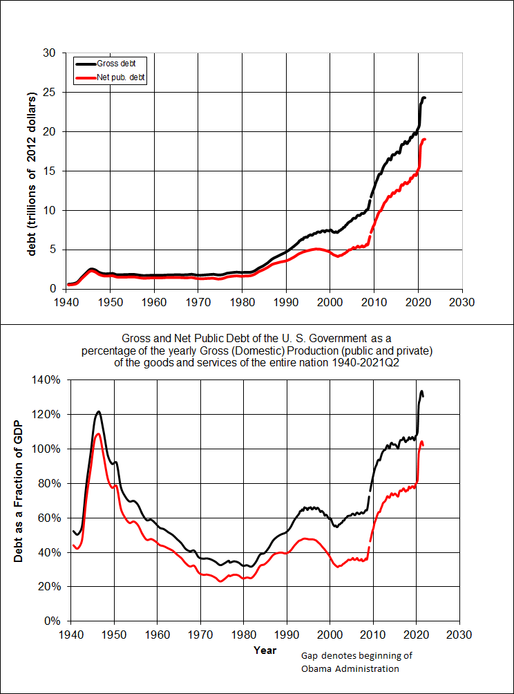
Zero debt is actually probably inefficient. There must be millions of pages of analysis on optimization of macro-economies. The US seems to do great with a debt-to-GDP ratio of about .6:

514px-USDebt.png


If we were to exactly balance our budget (never even needing to run a budget surplus) we would probably be back within the .6 tolerance level in a decade of normal growth. Manage it for two decades and we would be around .3, the lowest debt in the last hundred years.
 
Last edited:
Re: The 2012 Presidential Election Part I - The guns of August

Zero debt is actually probably inefficient. There must be millions of pages of analysis on optimization of macro-economies. The US seems to do great with a debt-to-GDP ratio of about .6:

514px-USDebt.png
I agree that some much, much lower level of debt would be ok. But, part of me says if allow some amount of debt, the politicians can't control themselves so it'd grow all over again. Not that we'll ever get there, but if we eliminated the debt, I'd argue to stay there, even if it's less than ideally efficient, just so if down the road a politician tried to run up some debt, it would be more difficult.
 
Re: The 2012 Presidential Election Part I - The guns of August

Debt on its own is a very useful tool. What becomes problematic is when servicing debt eats away too much of your cash flow.
 
Re: The 2012 Presidential Election Part I - The guns of August

Debt on its own is a very useful tool. What becomes problematic is when servicing debt eats away too much of your cash flow.

In order to have cash flow, your expenditures must be at most equal to revenue. This moment brought to you by poker player Tom Dwan's nickname.
 
Re: The 2012 Presidential Election Part I - The guns of August

Debt on its own is a very useful tool. What becomes problematic is when servicing debt eats away too much of your cash flow.
Absolutely. I don't know what the optimal level is. I'm sure it's very different for a person, a small company, a large company, a small country, and a large country.
 
Re: The 2012 Presidential Election Part I - The guns of August

But, part of me says if allow some amount of debt, the politicians can't control themselves so it'd grow all over again. Not that we'll ever get there, but if we eliminated the debt, I'd argue to stay there, even if it's less than ideally efficient, just so if down the road a politician tried to run up some debt, it would be more difficult.
I would actually agree with you. .6 may be better than 0, but 0 is way, way better than 1.0.
 
In order to have cash flow, your expenditures must be at most equal to revenue. This moment brought to you by poker player Tom Dwan's nickname.

That is why you buy big ticket items with debt and pay over time. :). Like my home.... And six vacation houses ;)
 
Back
Top