
At about this time of the season in prior years, there was an extremely analytical poster who would calculate the the possibe positions in which the various teams could end the season based on their current position and games remaining on their schedule. Does anyone remember which poster would put that together?With 6 games remaining, lets say best case is a split this weekend, a SO win vs PC or UMass and the rest losses. That gets you 6 points and to 26. NU and MC already have 26 and you lose the tie breaker so best case is 8th. You need Lowell to lose out along with Maine and VT to lose out with except the game they play where Maine can't get more than 2 points.
The most likely positive situation is you somehow jump VT into 10th at currently the homeless NU Huskies. A first round game at Lawler I don't think is a game you want first round.
USCHO Fan Forum
-
The USCHO Fan Forum has migrated to a new plaform, xenForo. Most of the function of the forum should work in familiar ways. Please note that you can switch between light and dark modes by clicking on the gear icon in the upper right of the main menu bar. We are hoping that this new platform will prove to be faster and more reliable. Please feel free to explore its features.
You are using an out of date browser. It may not display this or other websites correctly.
You should upgrade or use an alternative browser.
You should upgrade or use an alternative browser.
UNH- How Far West Do We Go?
- Thread starter norbert
- Start date

Chuck Murray
WIS & Effingwoods Hockey Almanac
I think it was (is?) a BU poster named Sean?? Haven't seen him on here lately, this is his usual time to shine ... hope he's OK?At about this time of the season in prior years, there was an extremely analytical poster who would calculate the the possibe positions in which the various teams could end the season based on their current position and games remaining on their schedule. Does anyone remember which poster would put that together?
I imagine if Quinnipiac were to join, they would consistently land in the 4-6 range, as I’m not sure how often they would come out on top against the likes of BC and PC 2-3X a year.I had a ticket for a seat at the AHA finals game at Hart Rink, but we did not arrive early enough to claims our seats so were part of the additional 800 standing (only 1290 seats). Obviously, the Holy Cross fire marshal looked the other way on that one. Game should have been played at the DCU, which I am sure Holy Cross could arrange should they join HEA.
Have it on good authority that when Bentley built their beautiful on-campus rink (capacity about 2200) a few years ago they were hoping that Quinnipiac would join HEA so that Bentley could replace them in the ECAC. Apparently Bentley has no interest in becoming the HEA cellar dweller.
Watch your back for breaking Potluck’s posting curfew, Will.
I haven’t heard much on if they plan to make the switch though. Perhaps they want to stay top dog in the ECAC, which they’ve been fairly consistently for 10+ years now?
I wonder if this is related to the recent gain of Romeo? Perhaps Carcone’s scholarship is going to Romeo, and maybe MS7 and co. Value Romeo moreso than Carcone?Per Heisenberg..Geno Carcone no longer a UNH recruit. This is kind of a head scratcher for me. 86 points in 104 games in USHL. Strongly reminds me of Saviano good playmaker plenty of upside. But who am I to question the coaching staff they really have a grip on things when it comes to recruits..Tyler Muszelik 25gp-ga 2.01-svp .935 16-5-4. Sardarian 41 points tied for 4th in NCAA and I won't get into Conmy.
Either that, or perhaps Carcone saw the sinking ship, and is thinking his development may be better suited elsewhere… I wish him all the best, but hope he doesn’t end up somewhere else in Hockey East.
Not sure if Lowell will lose our after their recent strong weekend. They finish with 2 at home against NU, away at Merrimack, and then home vs BU. I see at least 2 wins in there (perhaps more). I’m hoping for more than 26 points but we need a strong showing this weekend against UMA. Gotta play like they did on Friday if they want a fighting chance…With 6 games remaining, lets say best case is a split this weekend, a SO win vs PC or UMass and the rest losses. That gets you 6 points and to 26. NU and MC already have 26 and you lose the tie breaker so best case is 8th. You need Lowell to lose out along with Maine and VT to lose out with except the game they play where Maine can't get more than 2 points.
The most likely positive situation is you somehow jump VT into 10th at currently the homeless NU Huskies. A first round game at Lawler I don't think is a game you want first round.
Question for the group - what the heck is happening to Maine this year? Mind it UConn has had a decent year, but only one point for
Maine, after recent struggles against BU and PC. They may not even host a first round playoff game at this rate… I imagine Barr will adjust next year, but just curious to hear what others think if they have watched them more? Our sweep earlier this year, while still nice, Doesnt look as good with Maines struggles.
Wonder if Poirier will jump ship after a lackluster year for Maine… would love to have him in Durham!
Don't mind me....just thought that I would share some pertinent info. Apparently AD Rich's contract is up this year. Hmmm....any speculation on whether the new Prez will keep her??
Cheers!
Cheers!

TheGrouchyCat
Litter Box of Bad Ideas
Don't mind me....just thought that I would share some pertinent info. Apparently AD Rich's contract is up this year. Hmmm....any speculation on whether the new Prez will keep her??
Cheers!
What does the article say? Need an account.
What does the article say? Need an account.
Wren,
I’m glad you brought this up because I do think it’s worth having an honest conversation — but it has to be grounded in reality.
First, context matters. New Hampshire is ranked dead last in the country in state funding for public colleges and universities. UNH just lost roughly $20 million last year and is facing another potential state cut. That trickles down everywhere — including athletics. The department is operating with a skeleton crew compared to peer institutions.
On Santos — there is literally nothing Alison Rich could have done. He turned the job down twice and ultimately tripled his salary. That’s the reality of the marketplace. When someone can triple their pay, especially in this new era of college athletics, that’s not a retention issue — that’s economics.
Men’s basketball: Coach Davis is in year 3 of a 5-year deal. He isn’t going anywhere. And in today’s portal/NIL world, you’re essentially rebuilding a roster every single year. Where exactly is the NIL money supposed to come from at UNH? We don’t have a billionaire donor collective. Comparing UNH’s situation to institutions with real NIL infrastructure isn’t apples to apples.
Last year’s team had significant injuries and frankly wasn’t the right roster construction. This year’s group — if they stay together — has a chance to compete next year. That “if” is big in the portal era, but that’s not unique to UNH.
On women’s basketball — Coach Shoniker is in year 2. She had preseason injuries to players expected to contribute. I think she’s a very good coach. I’m all for giving her time. Programs don’t stabilize overnight, especially at places with resource limitations like ours.
Men’s soccer — Marc Hubbard built something special. Those are hard acts to follow. But again, when you lose established coaches, you’re not replacing them with bigger-budget hires — you’re hiring within your means.
Hockey — yes, it’s been a rough stretch. But that decline predates some of the current administrative decisions, and Hockey East has only gotten stronger top to bottom. Competing in that league without the resources of BC, BU, etc., is a constant uphill climb.
You mention attendance. That’s not just a UNH problem. That’s a nationwide issue outside the power conferences. The viewing habits of fans have changed dramatically.
The broader question is this: What specifically would another AD do better given the same financial constraints? That’s not a sarcastic question — I genuinely want to hear it. Because operating at a public institution in a state that chronically underfunds higher education puts very real ceilings on what’s possible.
It’s easy to look at a Twitter feed full of losses and feel frustrated. I get that. We all want more winning. But winning consistently requires investment — facilities, staffing, NIL support, recruiting budgets. Those things cost money. And UNH has less of it than almost anyone.
If it makes people feel better, Alison’s contract is up this year. The new president will make that call. From what I understand, they work well together, and I’d be surprised if she doesn’t return if she wants to.
I’ve learned this about message boards: when teams win, everything is brilliant. When they lose, everything is broken. The truth is usually more complicated.
Let’s absolutely have the conversation — but let’s base it on the full financial and structural picture facing State U

norbert
Well-known member
I don't follow Maine that closely so really not sure what is going on. It is strange though because it has been beaten into us that facilities produce winning and with the new back ice areas finished this year for hockey, the equation does not correlate.Not sure if Lowell will lose our after their recent strong weekend. They finish with 2 at home against NU, away at Merrimack, and then home vs BU. I see at least 2 wins in there (perhaps more). I’m hoping for more than 26 points but we need a strong showing this weekend against UMA. Gotta play like they did on Friday if they want a fighting chance…
Question for the group - what the heck is happening to Maine this year? Mind it UConn has had a decent year, but only one point for
Maine, after recent struggles against BU and PC. They may not even host a first round playoff game at this rate… I imagine Barr will adjust next year, but just curious to hear what others think if they have watched them more? Our sweep earlier this year, while still nice, Doesnt look as good with Maines struggles.
Wonder if Poirier will jump ship after a lackluster year for Maine… would love to have him in Durham!
Chuck Murray
WIS & Effingwoods Hockey Almanac
Thanks for poking your head back in and sharing this with us, Scott.What does the article say? Need an account.
 Any idea who authored the article? Context is always important.
As far as the AD is concerned ... wondering what the status of the incumbent AD down at Princeton might be? Could hold the key here ...
Chuck Murray
WIS & Effingwoods Hockey Almanac
Why would someone potentially considering a UMaine departure - with decent talent - not be looking further upstream for a new home?Wonder if Poirier will jump ship after a lackluster year for Maine… would love to have him in Durham!
Conmy, Dunlap, Carfagna, Muszelik, and Sardarian all left for more competitive programs. We're not that program yet. That's one of the problems UNH will continue to experience, so long as the current regime remains in situ. Once that foundational piece is fixed, UNH can work their way up through the remaining "to-do" list ...

JB
Desk Chair Coach
My response to all of that is when your resources are spread thin you pick one to be your winner and go start winning there, that builds credibility and winning leads to more winning.What does the article say? Need an account.
I guess, maybe hockey isn't the one you pick. I am not sure why you wouldn't pick the one sport the school has had history in, but I am certain a strategic argument could be made.
What always bothers me is the "victim thinking" of posts like these. Instead of the accountability thinking of acknowledging the situation and putting forward a plan. Last I checked multiple schools in Hockey East have much smaller athletic budgets.
Last edited:
The author posts under the name "unhsportsfan". Judging by the content of the message, I suspect it's someone who is either inside the UNH athletic department, or someone with very close ties to the UNH athletic department. You be the judge.Thanks for poking your head back in and sharing this with us, Scott.
As far as the AD is concerned ... wondering what the status of the incumbent AD down at Princeton might be? Could hold the key here ...
Poking my head back out.....carry on.........
Totally agree. I bet Poirier stays in Maine as this year has been an aberration of late and he likely sees the bigger picture. I imagine Carolina probably wants him to stay at least one (maybe 2) more years with continued development. Maybe with another bad year next year he jumps ship to a different team. If he plays like he did this year, he will certainly have a long list of suitors, and I can’t imagine UNH would be high on his list given recent results… but I can dream!Why would someone potentially considering a UMaine departure - with decent talent - not be looking further upstream for a new home?
Conmy, Dunlap, Carfagna, Muszelik, and Sardarian all left for more competitive programs. We're not that program yet. That's one of the problems UNH will continue to experience, so long as the current regime remains in situ. Once that foundational piece is fixed, UNH can work their way up through the remaining "to-do" list ...
norbert
Well-known member
I have to disagree with the reasons for departure. Conmy left for a check, Sardarian didn’t go to a more competitive program at the time (UNH just had won 20 games ie contract extension) and Moose left because he thought he’d be stuck behind Helleston again.Why would someone potentially considering a UMaine departure - with decent talent - not be looking further upstream for a new home?
Conmy, Dunlap, Carfagna, Muszelik, and Sardarian all left for more competitive programs. We're not that program yet. That's one of the problems UNH will continue to experience, so long as the current regime remains in situ. Once that foundational piece is fixed, UNH can work their way up through the remaining "to-do" list ...
I believe a lot of the this is Tom Coughlin with the Giants during their Super Bowl days and that reflection hasn’t happened yet.
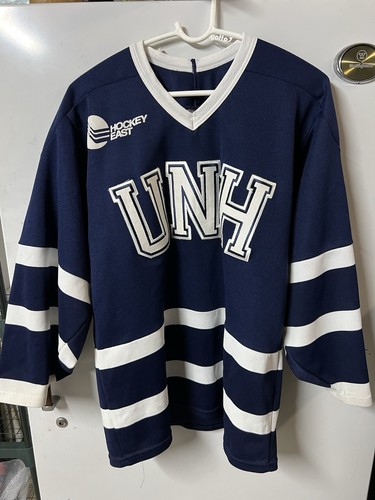
The interlocking NH on the shoulders was used by UNH in the late 70's to later 80's. Could be confused for a Yankees NY logo so the occasional "Yankees Suck" could be tossed at the wearer.The logo on the alternate jerseys is taken from (I believe?) the vintage UNH Football logo. SO much better than the blah logo UNH has used for 20+ years now.
There is only 1 Uni that should be used in Durham. Simple, classic, clean!

Also makes me wonder… if AD Rich is concerned with how budget cuts for this year may impact UNH (as it seems moreThanks for poking your head back in and sharing this with us, Scott.
As far as the AD is concerned ... wondering what the status of the incumbent AD down at Princeton might be? Could hold the key here ...
may be on the way) if she decides to leave on her own accord and go somewhere in the private sector? Perhaps if she feels her long term outlook at UNH is cloudy and if raises/bonuses (again, because of budget cuts) are put on hold for a period of time?
I’m not sure how this would influence the search for a new AD, as it probably wouldn’t look good to outsiders that our current AD left after a short tenure because of budget cuts etc.
The best bet may be to try and find someone young/inexperienced and try and catch lightning in a bottle for a few years before they move on to a bigger program etc. A high risk/high reward potential here, but it may be our best shot if Rich leaves and money is a major hindrance to get a top of the line candidate.
The concern would be football as we have talked about recently, and given the large recent investments in the new stadium / scoreboard…My response to all of that is when your resources are spread thin you pick one to be your winner and go start winning there, that builds credibility and winning leads to more winning.
I guess, maybe hockey isn't the one you pick. I am not sure why you wouldn't pick the one sport the school has had history in, but I am certain a strategic argument could be made.
What always bothers me is the "victim thinking" of posts like these. Instead of the accountability thinking of acknowledging the situation and putting forward a plan. Last I checked multiple schools in Hockey East have much smaller athletic budgets.
I agree hockey makes the most sense, and with the “potential” private investments in the Whitt renovations, I think that could really tip the scales in hockeys favor.
Someone more economically savvy in the dept. could look into how much money hockey used to make the school (higher attendance, merch, playoffs games, etc.) and then project what the school could make now if we improved our record to .500, to .600, etc. there’s probably a lot of publicly available data to help with these models, and obviously a lot of historical data from past seasons going back to our more glory days. I think the results would come back a no brainer that hockey is the best bet to be a “cash cow” for the school.
Still though, I imagine within the dept there will always be a strong push to try and make all sports as competitive as possible, and it will be hard to convince everyone in power to push “most of our the chips” into one program over another, even if it’s for a short period of time. High risk/high reward, but in our current situation it may be the best bet.
Last edited:
FlagUp17,
QU has gone 4-3-1 against HE this year. Wins vs. BC, Maine, UNH and BU, with losses to PC,UConn and MC (Yea!), and a tie against Maine. Rand Pecknold has built a terrific program down in Hamden. I agree they'd probably slot into the 4th to 6th slot, and perhaps even 3rd-5th.
QU has gone 4-3-1 against HE this year. Wins vs. BC, Maine, UNH and BU, with losses to PC,UConn and MC (Yea!), and a tie against Maine. Rand Pecknold has built a terrific program down in Hamden. I agree they'd probably slot into the 4th to 6th slot, and perhaps even 3rd-5th.
Last edited:

Darius
Go 'cats!
I just skimmed their thread. Apparently an assistant coach is a tad out of shape. Also Maine sucks. Always.Question for the group - what the heck is happening to Maine this year? Mind it UConn has had a decent year, but only one point for
Maine, after recent struggles against BU and PC. They may not even host a first round playoff game at this rate… I imagine Barr will adjust next year, but just curious to hear what others think if they have watched them more? Our sweep earlier this year, while still nice, Doesnt look as good with Maines struggles.