
What's new
USCHO Fan Forum

This is a sample guest message. Register a free account today to become a member! Once signed in, you'll be able to participate on this site by adding your own topics and posts, as well as connect with other members through your own private inbox!

  • The USCHO Fan Forum has migrated to a new plaform, xenForo. Most of the function of the forum should work in familiar ways. Please note that you can switch between light and dark modes by clicking on the gear icon in the upper right of the main menu bar. We are hoping that this new platform will prove to be faster and more reliable. Please feel free to explore its features.

The Sad Case of the Patient Protection and Affordable Care Act

Status
Not open for further replies.
Re: The Sad Case of the Patient Protection and Affordable Care Act

It appears that you misunderstand life expectancy.

Life expectancy is different at different ages (and also is different depending upon which mortality table you use...). The life expectancy of someone in their 40s is to a later age than the life expectancy of someone in their 20s because some of those 20-year olds have died along the way to 40.

According to the IRS life expectancy table used to calculate required minimum distributions from retirement plans, the life expectancy of a 65-year old is 20 years. The life expectancy of a 75-year old is 12.5 years (IRS Table V).

That table is probably a bit out of date these days. I read an article recently that asserted that the fastest-growing age cohort in the US is ages 90-99. The news shows used to make a big deal over people turning age 100; they've stopped because so many people are living past 100, it's no longer newsworthy.

A nice illustration of this in one figure:

FeatureAgingFigure1.png
 
Re: The Sad Case of the Patient Protection and Affordable Care Act

Another unintended consequence of PPACA: it greatly increases the demand for healthcare services yet includes clauses that likely will restrict supply. If the goal was to provide access to healthcare for all, the effect likely will be to create a two-tier healthcare system, one for the well-off; and one for everyone else.

Since this imbalance cannot be reconciled through price, it will most likely be reconciled through time.

We've seen a preview in Massachusetts; waiting times to see primary care physicians have been getting longer.

The full sad details are here.

http://online.wsj.com/article/SB100...7578980699719356.html?mod=WSJ_Opinion_LEADTop
 
Re: The Sad Case of the Patient Protection and Affordable Care Act

A nice illustration of this in one figure:
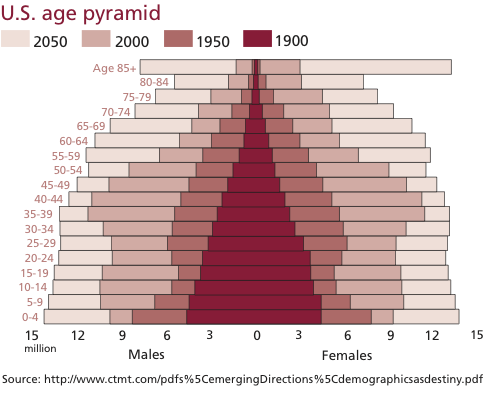
FeatureAgingFigure1.png

I'm skeptical, because this seems like the global warming hockey stick. Why do they think 85+ is going to shoot up so far when you compare the sizes of 75-84?
 
Re: The Sad Case of the Patient Protection and Affordable Care Act

I'm skeptical, because this seems like the global warming hockey stick. Why do they think 85+ is going to shoot up so far when you compare the sizes of 75-84?
Because the chart is also elongating. That 85+ includes 85-89, 90-94, 95-99, 100-104, etc...

Nobody within a given 5 year cohort will be larger than 80-84, but the number of cohorts are increasing.
 
Re: The Sad Case of the Patient Protection and Affordable Care Act

Another unintended consequence of PPACA: it greatly increases the demand for healthcare services yet includes clauses that likely will restrict supply.


This is contrary to how supply and demands actually works. Capital looks for a ready market.
 
Re: The Sad Case of the Patient Protection and Affordable Care Act

This is contrary to how supply and demands actually works. Capital looks for a ready market.
Only if the price can float higher so that there is a higher reward for investment. We already know how many doctors will be produced at today's prices; the only mechanism (in a free market) which would produce a greater supply than we have today is a greater price. If the price is capped (and with a larger and larger proportion of health care being performed at Medicare rates, this is increasingly the case), then there's no reason to expect that there will be more doctors.
 
Re: The Sad Case of the Patient Protection and Affordable Care Act

Only if the price can float higher so that there is a higher reward for investment. We already know how many doctors will be produced at today's prices; the only mechanism (in a free market) which would produce a greater supply than we have today is a greater price. If the price is capped (and with a larger and larger proportion of health care being performed at Medicare rates, this is increasingly the case), then there's no reason to expect that there will be more doctors.

However, as long as being a doctor is more lucrative than the typical profession, if you grow the supply of care recipients there will be more openings for doctors at providers, and where there are openings there will be applicants.

I think the quality argument is a much better one against caps -- you will attract fewer of the best and the brightest if they are paid less relative to law, business, academia, etc. Call it the Schoolteacher Dilemma.
 
Re: The Sad Case of the Patient Protection and Affordable Care Act

Because the chart is also elongating. That 85+ includes 85-89, 90-94, 95-99, 100-104, etc...

Nobody within a given 5 year cohort will be larger than 80-84, but the number of cohorts are increasing.

Then why do we not see similar progression in even the present?
 
Re: The Sad Case of the Patient Protection and Affordable Care Act

Then why do we not see similar progression in even the present?
We do. Compare the 85+ to 80-84 for 1900, 1950, and 2000. 85+ goes from a tiny fraction of 80-84 in 1900 to being a larger absolute value than 80-84 by 2000.

They should have added the additional cohorts to the chart to make it more obvious. As it is the chart is correct but misleading, because the "+" of the top cohort makes it far more years than the 5 years of every other cohort.
 
Re: The Sad Case of the Patient Protection and Affordable Care Act

However, as long as being a doctor is more lucrative than the typical profession, if you grow the supply of care recipients there will be more openings for doctors at providers, and where there are openings there will be applicants.

I think the quality argument is a much better one against caps -- you will no longer attract the best and the brightest if they are paid less relative to law, business, academia, etc. Call it the Schoolteacher Dilemma.
Except that the potential pool of applicants we're talking about are "people who have passed their medical boards." Once people are through med school, they still have to choose to go into primary care rather than specializing or going into concierge care, so the reward for primary care has to be higher relative to those other medical career choices, not just higher than law, business, etc.

I certainly agree that keeping the pay higher than law and business will improve the quality of the med school applicant pool, but that does no good if none of them choose primary care post graduation.
 
Re: The Sad Case of the Patient Protection and Affordable Care Act

However, as long as being a doctor is more lucrative than the typical profession, if you grow the supply of care recipients there will be more openings for doctors at providers, and where there are openings there will be applicants.

I think the quality argument is a much better one against caps -- you will attract fewer of the best and the brightest if they are paid less relative to law, business, academia, etc. Call it the Schoolteacher Dilemma.

It's the quality argument that is at the heart of the premium support model. Current Medicare capitation rates pay all providers the same, whether quality is good mediocre or lousy, whether there is innovation or stagnation. Premium support allows the good to drive out the bad.

Again, how is it premium support is controversial when the federal government has already been doing it for decades on their employees' health insurance plan, or the state of California on theirs? It's been around since at least 1978. There's plenty of empirical evidence to indicate that it works. It's also bi-partisan thanks to the Ryan (R) - Wyden (D) bill.
 
Re: The Sad Case of the Patient Protection and Affordable Care Act

Except that the potential pool of applicants we're talking about are "people who have passed their medical boards." Once people are through med school, they still have to choose to go into primary care rather than specializing or going into concierge care, so the reward for primary care has to be higher relative to those other medical career choices, not just higher than law, business, etc.

I certainly agree that keeping the pay higher than law and business will improve the quality of the med school applicant pool, but that does no good if none of them choose primary care post graduation.

Next time anyone goes to see their primary care physician, ask him / her for their opinion on PPACA. They are the ones most directly affected.

Mine will not be accepting any new applicants until existing patients die or move.
 
Re: The Sad Case of the Patient Protection and Affordable Care Act

Ireland, Greece, Spain, Portugal, Italy, Cyprus, France (to an extent), and Iceland if we're including countries not in the Eurozone in the Eurozone (Norway???)... I don't know, I'd say only two have decent to good economies (Germany and I'll assume Austria based on your post). So we're talking six or seven that are deep in the red and two in the black. That's not a very good sign for the Eurozone.

All have had massive problems as of late.

Yes but that isnt because of Universal Health Care, it is because of about 12 different factors including the stupidity of the EU as a whole. The Euro needs to be flushed down the toilet.

And while Norway is not in the Eurozone, Sweden is.
 
Re: The Sad Case of the Patient Protection and Affordable Care Act

Next time anyone goes to see their primary care physician, ask him / her for their opinion on PPACA. They are the ones most directly affected.

Mine will not be accepting any new applicants until existing patients die or move.
I see myriad health professionals every week of my life. Every single one...doctors, nurses, surgeons and specialists of every practice I see are very supportive of the legislation. Have not encountered a negative opinion yet among them.
 
Re: The Sad Case of the Patient Protection and Affordable Care Act

Whenever I visit my PCP he goes on a fifteen minute screed about how the insurance and pharmaceutical industries are destroying American medicine. Seriously, I always ask him if his blood pressure is high.

If we listened to our doctors those guys would be in jail.

Of the health care people I've encountered I would say they're about 70:30 in favor. Keep in mind I live in a very rural area where everybody below the rank of full MD is living within 5 miles of where their great-grandparents founded the local snake-biter cult.
 
Last edited:
Re: The Sad Case of the Patient Protection and Affordable Care Act

Of the health care people I've encountered I would say they're about 70:30 in favor. Keep in mind I live in a very rural area where everybody below the rank of full MD is living within 5 miles of where their great-grandparents founded the local snake-biter cult.
I've had a host of Medical issues in the last 2 years, I haven't talked to one Doc who is in favor of it. PCP, Gastros, Surgeons, Infusion Clinic Nurses, not one
 
Re: The Sad Case of the Patient Protection and Affordable Care Act

If I had a teenager who ran up a credit card debt on the emergency credit card, I'd cut up the credit card in front of him and tell him he's on his own until he pays me back (in fairness, I wouldn't give a credit card to any kid not in college - so my assumption is the kid should be somewhat self-sufficient anyway).

ah, but would you stop feeding him / her? would you not allow them back into your house?

That's what you suggested I would do in this situation, you know.

It's a gnarly situation with no easy answers, eh? :)

Everything doesn't always have to be constant warfare....
 
Status
Not open for further replies.
Back
Top