What's new
USCHO Fan Forum

This is a sample guest message. Register a free account today to become a member! Once signed in, you'll be able to participate on this site by adding your own topics and posts, as well as connect with other members through your own private inbox!

  • The USCHO Fan Forum has migrated to a new plaform, xenForo. Most of the function of the forum should work in familiar ways. Please note that you can switch between light and dark modes by clicking on the gear icon in the upper right of the main menu bar. We are hoping that this new platform will prove to be faster and more reliable. Please feel free to explore its features.

Business, Economics, and Taxes: Capitalism. Yay? >=(

Status
Not open for further replies.
Yes, there are poor neighborhoods in cities. There are poor neighborhoods in NYC -- it's also one of the richest cities in the world.

You guys do stick to your racist guns, I'll give you that. You are an honor to The Cause.

It's funny. You bitch about my choice of Oakland but don't deny the underlying point. SOP
 
It's funny. You ***** about my choice of Oakland but don't deny the underlying point. SOP

What underlying point? You offered a binary option. The answer to the question is not a binary choice.

Same with lots of shit you guys are so "concerned" about. "If you defund the police, then crime becomes rampant". Either, or. No. there's all sorts of alternatives that you guys refuse to even contemplate. Because it doesn't suit whatever "point" it is you think you're making.
 
4kprvh6glll71.jpg
 
For that 2nd graph, do you suppose that’s the average of the increases or the increase of the average? I think it’s the latter. It makes a difference - the US average wealth is skewed so high by the unequal distribution, so of course if you compare everyone’s “new” wealth to that old average, the average wouldn’t go up that much, but that hides the fact that hundreds of millions of Americans would be 10, 20, even 30x better off. I think the average of those increases would be a much bigger number, which would be more indicative of the net benefit” of the redistribution.

Tl;dr: increase of the average wealth is not interesting. The average wealth in the US would go up if you handed Jeff Bezos another $200B.
 
Last edited:
I'm still a little confused as to how the first one works. If you have $100 and 100 people, but one person has $100, the average is the same as if everyone had $1.
 
I'm still a little confused as to how the first one works. If you have $100 and 100 people, but one person has $100, the average is the same as if everyone had $1.

If you have 5 people, 4 have $1 and 1 has $6, that’s an average of $2. If you redistribute so each person has 2, then 4 people have 100% more and one person has 67% less. (400-67)/5 means that, on average, each person’s wealth has increased by 83%, but the average wealth is still $2 (no change).

Average of the increases = +83%
increase of the average = 0%
 
Last edited:
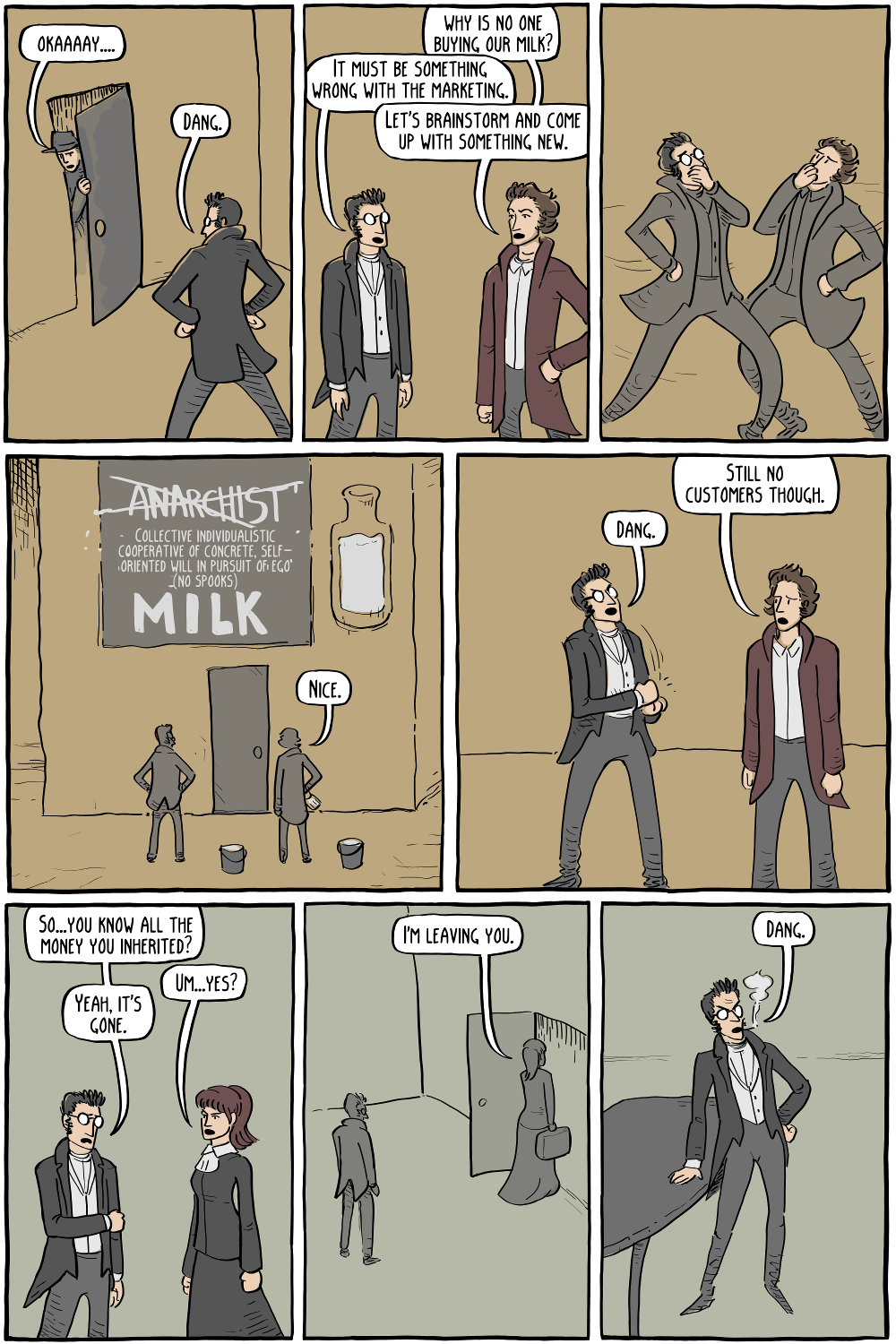
Note: this actually happened.

In the spring of 1845, Max Stirner gambled away all of his wife's inheritance on a centralized milk distribution business. Supposedly he wanted to use the business to both prove his ideas would work in practice, and to set him up for life, so he wouldn't have to worry about money and could just write. Well, the business failed almost immediately, because he had trouble finding customers, possibly because of his inability to relate to his customers, his inexperience in business, and him alienating people with his strange egoistic anarchist politics (details are scarce, so it is mostly speculation). He was made fun of ruthlessly by his contemporary intellectuals, and his wife of two years left after he blew all of their money. For the rest of his life he lived off the very meager income he got from writing.

To add insult to injury, the idea of a centralized milk distributor was a quite good one, and a highly successful business in the same vein popped up soon after, according to his biography by John Henry Mackay:

How sound the idea of the enterprise was, in spite of the unsuccessful attempt, was later shown by Klingel-Bolle, which is well known today by every Berlin child. It mixed its milk, if not with water, then with a big portion of Christianity and thus contributed not inconsiderably to the success of its business.

It turned out that Christianity worked better than anarchism as a selling point for milk. Who could have predicted that? Not Max Stirner, apparently.

 
Last edited:
See, he just hadn't figured out how to conceal his anarchist union of egoists behind a banal, false face of cheer like the ruthless capitalists do.
 
Status
Not open for further replies.
Back
Top