What's new
USCHO Fan Forum

This is a sample guest message. Register a free account today to become a member! Once signed in, you'll be able to participate on this site by adding your own topics and posts, as well as connect with other members through your own private inbox!

  • The USCHO Fan Forum has migrated to a new plaform, xenForo. Most of the function of the forum should work in familiar ways. Please note that you can switch between light and dark modes by clicking on the gear icon in the upper right of the main menu bar. We are hoping that this new platform will prove to be faster and more reliable. Please feel free to explore its features.

Space Exploration II: Always Looking up

Artemis launch window starts at 6:24 PM EST on Wednesday. Big solar flare today won't help.

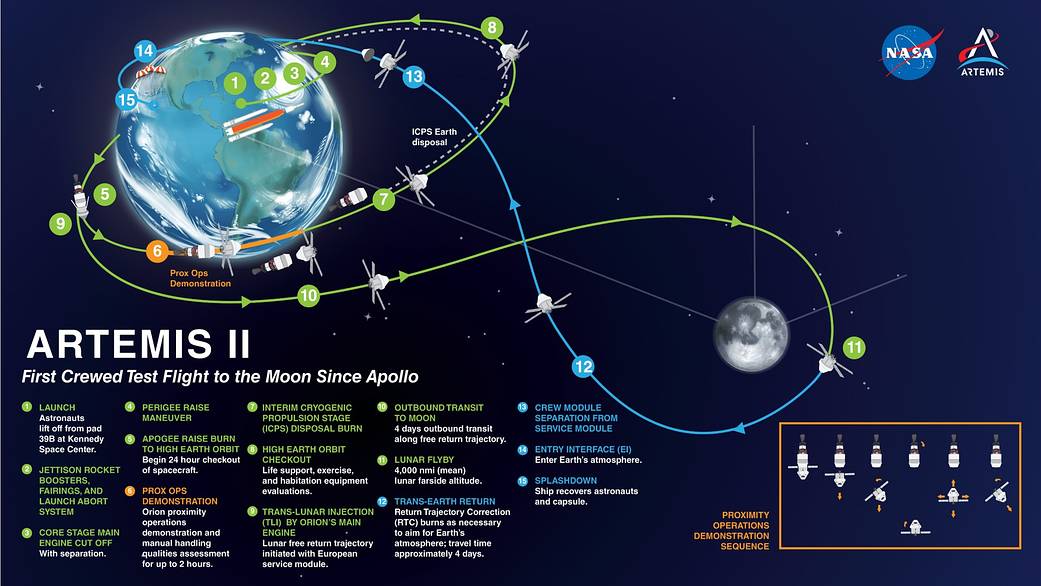
artemis_2_map_october_2021.jpg
 
Last edited:
Under L-14 hours (L-13H27M) now. No issues. Weather is 80% good for launch. Next countdown step is Ground Launch Sequencer (GLS) activation at L-13H15M. The GLS "is the automated software system controlling the final countdown, activating at L-13 hours 15 minutes to manage ground systems. It handles critical tasks including terminal count initiation, propellant tank pressurization, and the final handover to onboard computers at T-30 seconds."

The countdown:

L-49 hours 50 minutes and counting (complete)


  • L-49H50M – Launch team arrives to stations
  • L-49H40M – Countdown clock begins
  • L-49H40M – L-42H30M: Liquid oxygen (LOX)/Liquid hydrogen (LH2) system
    preparations for vehicle loading
  • L-45H30M – L-44H: Orion spacecraft powered up
  • L-42H20M – L-41H: Core stage powered up
  • L-42H10M – L-40H30M: Interim cryogenic propulsion stage (ICPS) powered up
  • L-39H45M – L-35H30M: Final preparations of the four RS-25 engines

L-35 hours and counting (complete)


  • L-34H45M – L-34H10M: ICPS is powered down
  • L-33H30M – L-29H30M: Charge Orion flight batteries to 100%
  • L-31H30M – L-24H30M: Charge core stage flight batteries
  • L-20H15M – L-18H45M: ICPS is powered up for launch

L-16 hours and counting


  • L-15H30M – L-14H: All non-essential personnel leave Launch Complex 39B (complete)
  • L-14H15M – L-12H05M: Air-to-gaseous nitrogen (GN2) changeover and rocket
    cavity inerting (complete)
  • L-13H15M – L-11H45M: Ground launch sequencer (GLS) activation

L-13 hours and counting


  • L-12H35M – L-9H50M: 2-hour 45-minute built in countdown hold begins
  • L-10H50M – Launch team decides “go” or “no-go” to begin tanking
  • L-10H50M – L-9H35M: Orion cold soak
  • L-10H40M – L-10H35M: Core stage LOX transfer line chilldown
  • L-10H40M – L-9H55M: Core stage LH2 chilldown
  • L-10H25M – L-9H40M: Core stage LOX main propulsion system chilldown

L-10 hours and counting


  • L-9H55M – L-9H25M: Core stage LH2 slow fill start
  • L-9H50M – Resume T-Clock from T-8H10M
  • L-9H40M – L-9H30M: Core stage LOX slow fill
  • L-9H30M – L-6H40M: Core stage LOX fast fill
  • L-9H25M – L-8H: Core stage LH2 fast fill
  • L-9H05M – L-8H30M: ICPS LH2 chilldown
  • L-8H30M – L-7H45M: ICPS LH2 fast fill start
  • L-8H – L-7H55M: Core stage LH2 topping
  • L-7H55M – terminal count: Core stage LH2 replenish
  • L-7H45M – L-7H20M: ICPS LH2 vent and relief test
  • L-7H20M – L-7H10M: ICPS LH2 tank topping start
  • L-7H05M – terminal count: ICPS LH2 replenish
  • L-6H40M – L-6H10M: Orion communications system activated (radio frequency to mission control)
  • L-6H40M – L-6H05M: Core stage LOX topping
  • L-6H40M – L-6H30M: ICPS LOX main propulsion system chilldown
  • L-6H30M – L-5H45M: ICPS LOX fast fill
  • L-6H10M – Stage pad rescue
  • L-6H10M: – Closeout crew assemble
  • L-6H05M – terminal count: Core stage LOX replenish

L-6 hours and counting


  • L-6H – Flight crew weather brief
  • L-5H45M – L-5H30M: ICPS LOX vent and relief test
  • L-5H30M – L-5H10M: ICPS LOX topping
  • L-5H10M – terminal count: ICPS LOX replenish
  • L-5H10M – All stages replenish
  • L-5H10M – Start 1-hour 10-minute built in hold
  • L-5H10M – L-4H55M: Closeout crew to white room
  • L-4H40M – L-4H10M: Flight crew deployment to pad
  • L-4H: Flight crew board Orion
  • L-3H40M – L-3H10M: Crew module hatch preps and closure
  • L-3H10M – L-2H45M: Counterbalance mechanism hatch sealpress decay
    checks
  • L-2H20M – L-1H40M: Crew module hatch service panel install/closeouts
  • L-1H40M – L1H30M: Launch abort system (LAS) hatch closure for flight
  • L-1H10M – Launch director brief – rocket & thermal protection system scan results with the imagery console
  • L-50M – L-40M: Closeout crew departs Launch Complex 39B
  • L-50M – Final NASA test director briefing is held

L-40 minutes and holding


  • L-40M – Built in 30-minute countdown hold begins

L-25 minutes and holding


  • L-25M – Transition team to Orion to Earth communication loop following final NTD briefing
  • L-17M – Launch director polls team to ensure they are “go” for launch
  • L-15M – Flight crew visors down
  • L-14M – Flight crew short purge verification

T-10 minutes and counting


  • T-10M – GLS initiates terminal count
  • T-8M – Crew Access Arm retract
  • T-6M – GLS go for core stage tank pressurization
  • T-6M – Orion ascent pyros are armed
  • T-6M – Orion set to internal power
  • T-5M57S – Core stage LH2 terminate replenish
  • T-5M20S – LAS capability is available
  • T-5M20S – NTD lets commander knows LAS capability is available
  • T-4M40S – GLS go for LH2 high flow bleed check
  • T-4M30S – Flight termination system armed
  • T-4M – GLS is go for core stage auxiliary power unit (APU) start
  • T-4M – Core Stage APU starts
  • T-4M – Core stage LOX terminate replenish
  • T-3M30S – ICPS LOX terminate replenish
  • T-3M10S – GLS go for purge sequence 4
  • T-2M02S – ICPS switches to internal battery power
  • T-2M – Booster switches to internal batter power
  • T-1M30S – Core stage switches to internal power
  • T-1M20S – ICPS enters terminal countdown mode
  • T-50S – ICPS LH2 terminate replenish
  • T-33S – GLS sends “go for automated launch sequencer” command
  • T-30S – Core stage flight computer to automated launching sequencer
  • T-12S – Hydrogen burn off igniters initiated
  • T-10S – GLS sends the command for core stage engine start
  • T-6.36S– RS-25 engines startup

T-0


  • Booster ignition, umbilical separation, and liftoff

Inside the terminal countdown, teams have a few options to hold the count if needed.


  • The launch team can hold at 6 minutes for the duration of the launch window, less the 6 minutes needed to launch, without having to recycle back to 10 minutes.
  • If teams need to stop the clock between T-6 minutes and T-1 minute, 30 seconds, they can hold for up to 3 minutes and resume the clock to launch. If they require more than 3 minutes of hold time, the countdown would recycle back to T-10.
  • If the clock stops after T-1 minute and 30 seconds, but before the automated launch sequencer takes over, then teams can recycle back to T-10 to try again, provided there is adequate launch window remaining.
  • After handover to the automated launch sequencer, any issue that would stop the countdown would lead to concluding the launch attempt for that day.
 
Last edited:
GLS activation passed without error and I am going to bed at 2:13 PT (5:13 ET).

Coming up in

2:22 Go for tanking
6:32 Orion comms activation
7:12 Weather briefing (cross your fingers)
9:10 Crew boards
12:54 Go for launch
13:11 Liftoff (18:24 ET)
 
L minus 0:49:32

NADA coverage has fed in the happy talk derp for the gen pop instead of the space center, so that is unlistenable now.

I am looking for the real audio feed now.
 
IINM this is only the 11th "first time" for a new manned vehicle in history:
  • Vostok: Yuri Gagarin (April 12, 1961)
  • Mercury: Alan Shepard (May 5, 1961)
  • Voskhod: Vladimir Komarov, Konstantin Feoktistov, Boris Yegorov (October 12, 1964)
  • Gemini: Gus Grissom and John Young (March 23, 1965)
  • Soyuz: Vladimir Komarov (April 23, 1967)
  • Apollo: Wally Schirra, Donn Eisele, Walter Cunningham (October 11, 1968)
  • Space Shuttle STS-1: John Young and Robert Crippen (April 12, 1981)
  • Shenzhou: Yang Liwei (October 15, 2003)
  • SpaceShipOne SS1: Mike Melvill (June 21, 2004)
  • SpaceX Commercial Crew Program Demo-2: Bob Behnken and Doug Hurley (May 30, 2020)
  • Artemis: Reid Wiseman, Victor Glover, Christina Koch, Jeremy Hansen (April 1, 2026)
 
Comic Book Guy notes the GO/NO GO was not aired but they are still moving forward on 18:24. T minus 10 minutes is terminal count. That's just 9 minutes away.
 
Back
Top