
USCHO Fan Forum
-
The USCHO Fan Forum has migrated to a new plaform, xenForo. Most of the function of the forum should work in familiar ways. Please note that you can switch between light and dark modes by clicking on the gear icon in the upper right of the main menu bar. We are hoping that this new platform will prove to be faster and more reliable. Please feel free to explore its features.
You are using an out of date browser. It may not display this or other websites correctly.
You should upgrade or use an alternative browser.
You should upgrade or use an alternative browser.
Space Exploration II: Always Looking up
- Thread starter MichVandal
- Start date


Kepler
I loafe and invite my soul
3I/ATLAS makes its closest approach to Earth Friday night. It is predicted to drop to 11.3 magnitude, making it visible in my 8" Dobsonian. The trick will be locating it. I do not have a computer driven goto system or even a calibrated azimuth setting mount.
I will use star hopping. At the moment, 3I/ATLAS is the vertex of right angle with Regulus and Zosma in Leo, which means... I could actually find it.
If I somehow do I'll snap a shot.
I will use star hopping. At the moment, 3I/ATLAS is the vertex of right angle with Regulus and Zosma in Leo, which means... I could actually find it.
If I somehow do I'll snap a shot.


Kepler
I loafe and invite my soul
So, I was worried that I had misunderstood about 3I/ATLAS and "closest approach" would not equal "maximum brightness" because I checked this site Thursday morning and the magnitude was 15.6 -- way, way dimmer the faintest object I can see even in perfect conditions with my scope (roughly 13.5 -- magnitude are brighter the lower the number is). Welp, I checked just now, 24 hours later, and it is up to 11.3! Each unit in magnitude equals a brightness difference of 2.5x, so 3I/ATLAS increased more than 10x in brightness in one day! To put that in perspective, Venus' variance between brightest and dimmest, which is quite dramatic by standards of astronomical objects, is 2 magnitudes (5x). That takes 110 days.
Last edited:

Handyman
Hug someone you care about...

Jonathan Cohn (@jonathancohn.bsky.social)
16 Democratic senators joined Republicans in confirming a close ally of Elon Musk as head of NASA: Baldwin Cantwell Durbin Fetterman Gallego Gillibrand Hassan Heinrich Kaine Kelly Kim King Schiff Shaheen Slotkin Warner
 bsky.app
Kepler
I loafe and invite my soul
Kelly makes me put outrage on pause. He is certainly the only Member with even a smidge of understanding the relevant technical and political issues. Yes, I know, he was only the bus driver, not an astronomer, but he does have more of an appreciation of what NASA needs that almost any of us (our rocket scientist is on the clock).
I gotta hear him explain before I defenstrate.
It is most likely the crass grift for keeping funding of AZ space companies in which case fuck him. But let's say there is a non-trivial chance he has a legit reason.
I gotta hear him explain before I defenstrate.
It is most likely the crass grift for keeping funding of AZ space companies in which case fuck him. But let's say there is a non-trivial chance he has a legit reason.
Kepler
I loafe and invite my soul
Amateur livestream from last night. He was getting 50k views a night until the last 2 weeks. Now it's half a million.
It is really quite something to see an astronomical object move in real time against the star backdrop. It happens in SF movies all the time, but in real life, other than artificial satellites, that does not happen. 3I/ATLAS is very close and it is not dawdling.
It is really quite something to see an astronomical object move in real time against the star backdrop. It happens in SF movies all the time, but in real life, other than artificial satellites, that does not happen. 3I/ATLAS is very close and it is not dawdling.

Kepler
I loafe and invite my soul
It maxed out at 11.3 but I was unable to find it.3I/ATLAS makes its closest approach to Earth Friday night. It is predicted to drop to 11.3 magnitude, making it visible in my 8" Dobsonian. The trick will be locating it. I do not have a computer driven goto system or even a calibrated azimuth setting mount.
I will use star hopping. At the moment, 3I/ATLAS is the vertex of right angle with Regulus and Zosma in Leo, which means... I could actually find it.
If I somehow do I'll snap a shot.
Highest resolution photo I could find, from Hubble in July. Damn nice shot. We are talking about an object 7 miles wide which at the time of the photo was 258 million miles away! Note the streaks are because the telescope is tracking 3I/ATLAS to maximize exposure. It is actually the object moving against an (almost) stationary backdrop, not the reverse.

Kepler
I loafe and invite my soul
This is how the apes will trap us on this ball permanently unless we strike first and get rid of them.
Two NATO-nation intelligence services suspect Russia is developing a new anti-satellite weapon to target Elon Musk's Starlink constellation with destructive orbiting clouds of shrapnel, with the aim of reining in Western space superiority that has helped Ukraine on the battlefield.
Intelligence findings seen by The Associated Press say the so-called "zone-effect" weapon would seek to flood Starlink orbits with hundreds of thousands of high-density pellets, potentially disabling multiple satellites at once but also risking catastrophic collateral damage to other orbiting systems.
Kepler
I loafe and invite my soul
The sections are "national"? Huh, TIL. I thought everybody pooled their resources and everything is community property.Considering their new plan for a space station isn't to launch a new facility into orbit, but instead just build off their 30 year old ISS module after separating it from the US and EU sections....

aparch
Acetaminamerican
I will never forgive anyone who voted for Yam Tits. 
 www.jalopnik.com
Now NASA Is Closing Its Biggest Library, Some Of Which Could Be Lost Forever - Jalopnik
At the start of 2022, the space agency had eleven libraries; as of Friday, it's now down to just three.
www.jalopnik.com
Handyman
Hug someone you care about...

@tmoney2007.bsky.social
If it happens, it ain't gonna be on a Starship, I'm confident of that.
bsky.app

Noah Shachtman (@noahshachtman.bsky.social)
The 1st Trump admin swore they'd put an American on the Moon ... by 2024. "Everyone knew," one NASA source says, "it was pretty much bullshit.” Now the 2nd Trump admin is swearing it'll happen by 2028. Small problem: Musk got the sole-source contract to build the lunar lander, and hasn't...
bsky.app

FadeToBlack&Gold
Proud Statist
Despite the fact that we've been there before and should know all of the challenges and risks, I'm 100% sure that the billionaires will find a way to cut corners and carelessly kill at least a handful of astronauts in their rush to be the first to get American boots back on the lunar surface.
Same with the bullshit Mars missions, they don't give a fuck who gets killed in the race when their life isn't personally on the line. And even if it is, well...we're all going to die as pioneers, my friends!
Same with the bullshit Mars missions, they don't give a fuck who gets killed in the race when their life isn't personally on the line. And even if it is, well...we're all going to die as pioneers, my friends!
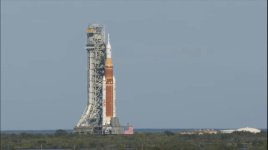
 It's gorgeous!
FadeToBlack&Gold
Proud Statist
It is pretty cool to see rockets without an overpriced 70s-era glider strapped to the underside of them any longer.