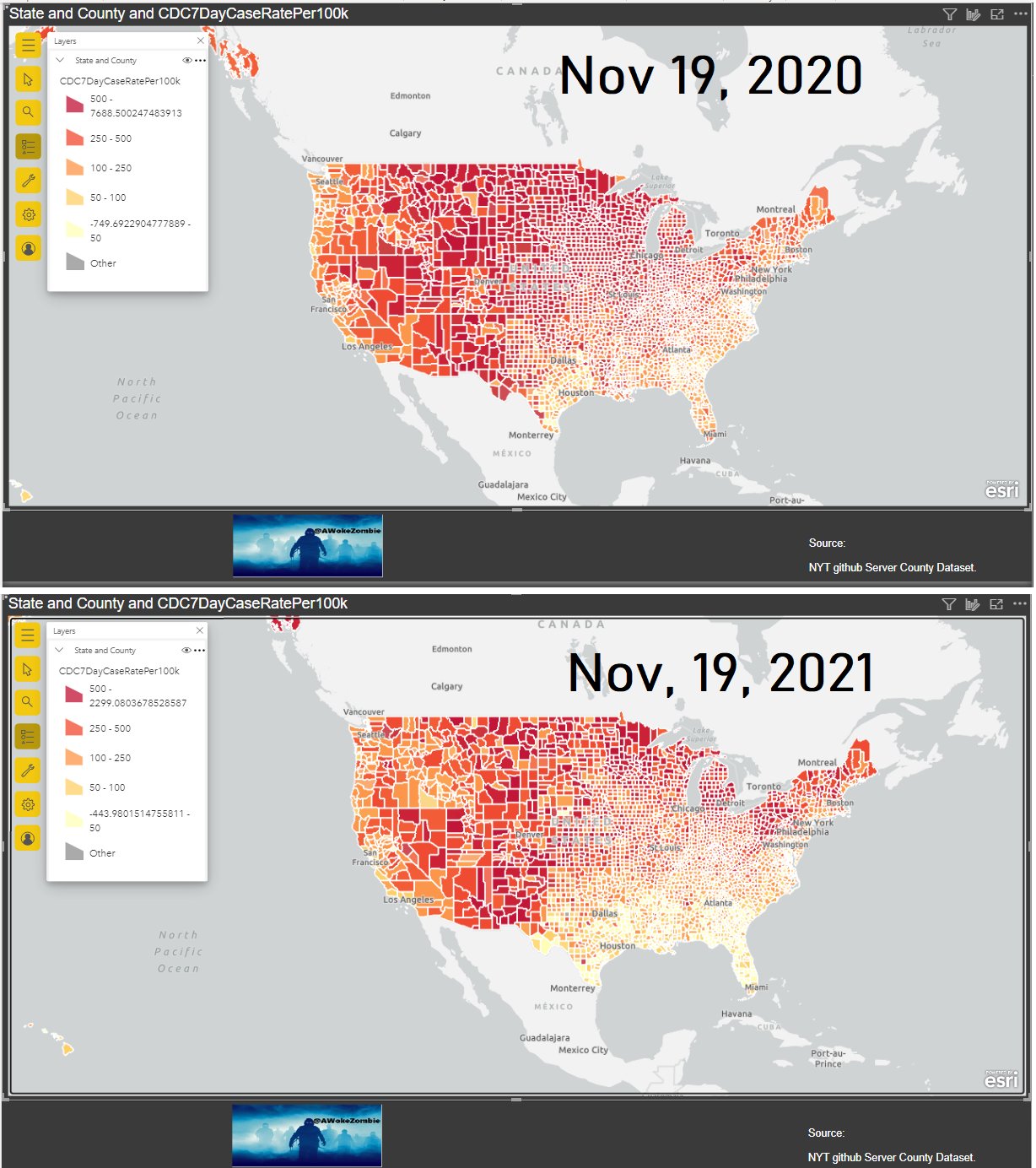
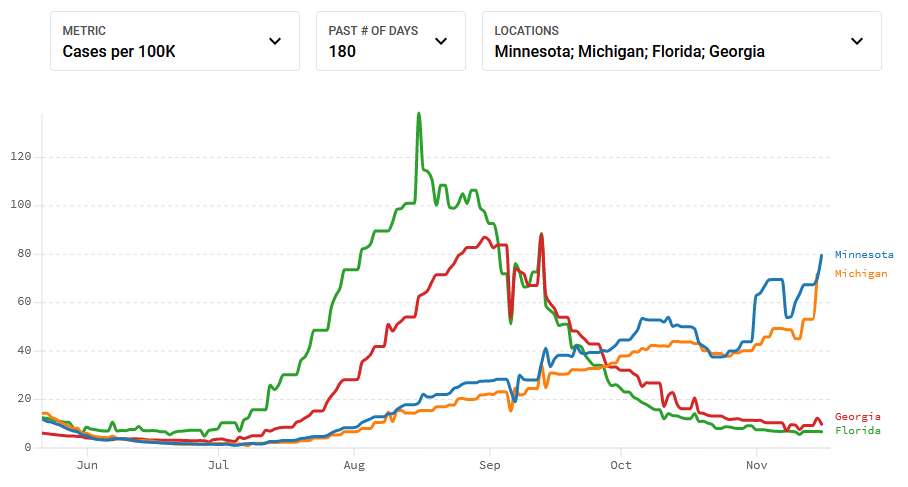
Flu season in northern latitudes is from November to March, the coldest months. In southern latitudes, it is from May until September. In the tropics, there is not much flu at all and no real flu season.
There was no shortage of hypotheses. Some said flu came in winter because people are indoors; and children are in school, crowded together, getting the flu and passing it on to their families.
Others proposed a diminished immune response because people make less vitamin D or melatonin when days are shorter. Others pointed to the direction of air currents in the upper atmosphere. But many scientists were not convinced.
“We know one of the largest factors is kids in school -- most of the major epidemics are traced to children,” said Dr. Jonathan McCullers, a flu researcher at St. Jude Children’s Research Hospital in Memphis. “But that still does not explain wintertime. We don’t see flu in September and October.”
As for the crowding argument, Dr. McCullers said, “That never made sense.” People work all year round and crowd into buses and subways and planes no matter what the season.
“We needed some actual data,” Dr. McCullers added.
But getting data was surprisingly difficult, Dr. Palese said.
The ideal study would expose people to the virus under different conditions and ask how likely they were to become infected. Such a study, Dr. Palese said, would not be permitted because there would be no benefit to the individuals.
There were no suitable test animals. Mice can be infected with the influenza virus but do not transmit it. Ferrets can be infected and transmit the virus, but they are somewhat large, they bite and they are expensive, so researchers would rather not work with them.
To his surprise, Dr. Palese stumbled upon a solution that appeared to be a good second best.
Reading a paper published in 1919 in the Journal of the American Medical Association on the flu epidemic at Camp Cody in New Mexico, he came upon a key passage: “It is interesting to note that very soon after the epidemic of influenza reached this camp, our laboratory guinea pigs began to die.” At first, the study’s authors wrote, they thought the animals had died from food poisoning. But, they continued, “a necropsy on a dead pig revealed unmistakable signs of pneumonia.”
Dr. Palese bought some guinea pigs and exposed them to the flu virus. Just as the paper suggested, they got the flu and spread it among themselves. So Dr. Palese and his colleagues began their experiments.
By varying air temperature and humidity in the guinea pigs’ quarters, they discovered that transmission was excellent at 41 degrees. It declined as the temperature rose until, by 86 degrees, the virus was not transmitted at all.
The virus was transmitted best at a low humidity, 20 percent, and not transmitted at all when the humidity reached 80 percent.
The animals also released viruses nearly two days longer at 41 degrees than at a typical room temperature of 68 degrees.
Flu viruses spread through the air, unlike cold viruses, Dr. Palese said, which primarily spread by direct contact when people touch surfaces that had been touched by someone with a cold or shake hands with someone who is infected, for example.
Flu viruses are more stable in cold air, and low humidity also helps the virus particles remain in the air. That is because the viruses float in the air in little respiratory droplets, Dr. Palese said. When the air is humid, those droplets pick up water, grow larger and fall to the ground.
But Dr. Palese does not suggest staying in a greenhouse all winter to avoid the flu. The best strategy, he says, is a flu shot.
It is unclear why infected animals released viruses for a longer time at lower temperatures. There was no difference in their immune response, but one possibility is that their upper airways are cooler, making the virus residing there more stable.
Flu researchers said they were delighted to get some solid data at last on flu seasonality.
“It was great work, and work that needed to be done,” said Dr. Terrence Tumpe, a senior microbiologist at the Centers for Disease Control and Prevention.
Dr. McCullers said he was pleased to see something convincing on the flu season question.
“It was a really interesting paper, the first really scientific approach, to answer a classic question that we’ve been debating for years and years,” he said.