What's new
USCHO Fan Forum

This is a sample guest message. Register a free account today to become a member! Once signed in, you'll be able to participate on this site by adding your own topics and posts, as well as connect with other members through your own private inbox!

  • The USCHO Fan Forum has migrated to a new plaform, xenForo. Most of the function of the forum should work in familiar ways. Please note that you can switch between light and dark modes by clicking on the gear icon in the upper right of the main menu bar. We are hoping that this new platform will prove to be faster and more reliable. Please feel free to explore its features.

Space Exploration II: Always Looking up

Starship 13 launch finally took place. Haven't looked up details, but it apparently did not go ka-boom this time.

Heard an interesting bit on CNBC this AM, SpaceX is starting to refuse customers for payload for Falcon and Falcon Heavy and are slowing their launch schedule in an apparent "all-in" move to Starship.

Also, just a reminder that when using a Starship variant to land on, and take off from, the moon, Starship will need somewhere between 8 and 20 refuel stops in orbit before heading to the moon.
 
Last edited:
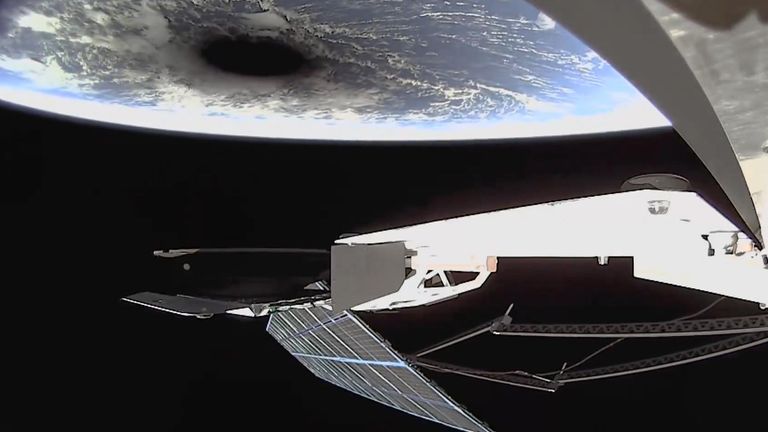
A very interesting way to look at a solar eclipse:

skynews-eclipse-solar-eclipse_6515471.jpg
 
SpaceX is launching their Buck Rogers Starship for the 14th time, this time it's scheduled for its first orbital flight.
 
An hour 10 into spaceflight, and it hasn't gone boom, it's delivering the Starlink payloads as designed, and it's on its way to recording its first full orbital flight.

I'm a little shocked they got their shit figured out.
 
An hour 10 into spaceflight, and it hasn't gone boom, it's delivering the Starlink payloads as designed, and it's on its way to recording its first full orbital flight.

I'm a little shocked they got their shit figured out.
Fast failure really was quick. Contrast with NASA and Apollo, from the first Saturn V to landing on the moon was an epicly long 21 months. Good thing X is so very fast compared to history. The progress that has been made…..
 
Fast failure really was quick. Contrast with NASA and Apollo, from the first Saturn V to landing on the moon was an epicly long 21 months. Good thing X is so very fast compared to history. The progress that has been made…..
To be fair, though, Apollo was also built by industry, not NASA itself:
  • North American Aviation: Built the Apollo Command and Service Modules (CSM).
  • Grumman Aircraft Engineering Corporation: Designed and built the Apollo Lunar Module (LM).
  • Boeing, Douglas Aircraft, and IBM: Constructed the various stages of the Saturn V launch vehicle.
  • Rocketdyne: Developed the F-1 and J-2 rocket engines.
  • Raytheon: Manufactured the Apollo Guidance Computer.
  • Subcontractors: Those prime contractors relied on a massive network of hundreds of thousands of subcontractors and suppliers (such as Texas Instruments) providing specialized parts, electronics, and materials.
The "only" difference is that NASA subcontracted with SpaceX to act as a prime integrator as well as a hardware manufacturer (which is a big difference). The money is in the hardware, so there's little wonder that industry is not as good at being a prime integrator - why would they focus on that, when it's not very profitable? Let's get right to building parts instead! And then they wonder why those parts don't come together to form a coherent whole that actually works. The learning that the are getting from "failing fast" is not learning about new technology or materials - we're just re-learning that we should have adhered to systems engineering processes that have been so successful in the past.

The model works much better when the USG takes the non-profitable role and just hires companies to build hardware to their specs. That way the companies' profit motive is properly aligned with succeeding in manufacturing the hardware - but in this case it would be the *right* hardware.
 
To be fair, though, Apollo was also built by industry, not NASA itself:
  • Grumman Aircraft Engineering Corporation: Designed and built the Apollo Lunar Module (LM).

My dad, to be exact.

But I don't have any legacy issues of my own, no siree. Still plenty of time to win a Nobel Prize...

P8ilx0e.gif
 
To be fair, though, Apollo was also built by industry, not NASA itself:
  • North American Aviation: Built the Apollo Command and Service Modules (CSM).
  • Grumman Aircraft Engineering Corporation: Designed and built the Apollo Lunar Module (LM).
  • Boeing, Douglas Aircraft, and IBM: Constructed the various stages of the Saturn V launch vehicle.
  • Rocketdyne: Developed the F-1 and J-2 rocket engines.
  • Raytheon: Manufactured the Apollo Guidance Computer.
  • Subcontractors: Those prime contractors relied on a massive network of hundreds of thousands of subcontractors and suppliers (such as Texas Instruments) providing specialized parts, electronics, and materials.
The "only" difference is that NASA subcontracted with SpaceX to act as a prime integrator as well as a hardware manufacturer (which is a big difference). The money is in the hardware, so there's little wonder that industry is not as good at being a prime integrator - why would they focus on that, when it's not very profitable? Let's get right to building parts instead! And then they wonder why those parts don't come together to form a coherent whole that actually works. The learning that the are getting from "failing fast" is not learning about new technology or materials - we're just re-learning that we should have adhered to systems engineering processes that have been so successful in the past.

The model works much better when the USG takes the non-profitable role and just hires companies to build hardware to their specs. That way the companies' profit motive is properly aligned with succeeding in manufacturing the hardware - but in this case it would be the *right* hardware.
So you are saying that multiple private companies, at the very dawn of CAD, years before electronic communication, all managed to coordinate their designs, production, and testing while inventing thousands of new ideas and technologies all managed to put a man on the moon and bring him safely back to earth before a time limit without any flight failures and including a long gap due to a testing disaster?

Imagine how fast they could have gone if they used “fast failure” when working with years of experience (both internal and from nasa), using the state of the art computer systems and not having to invent new technologies and stuff?
 
I see what you are saying, but while I have no proof I think it likely that engineering design, fabrication, testing, and coordination don't just develop independent of lessons learned and best practices. Things are different now, but those differences are probably suited to the mature state of the industry and the production cycle now. Those guys in the 60s had a system that was right for them, then.

Other than the waste, fraud, and abuse that is a byproduct of free enterprise, and the red tape, delays, and penny-wise pound-foolish political behavior of government, which is a wash across all ages, I suspect what we have now is what works best, on the whole, for where we find ourselves in the technological cycle.

But I leave it to LynahFan as he knows better from closer experience and a more sophisticated understanding of an industry I am only on the periphery of.
 
Here's what our friendly neighborhood AI said:

Key Reasons for the Shift in Pace
  • Risk Tolerance & Safety: In the 1960s Space Race, the United States accepted massive physical risks and high failure rates to beat the Soviet Union to the Moon. Today, human spaceflight and aviation demand stringent safety standards, exhaustive testing, and near-zero failure rates.
  • Regulatory & Certification Hurdles: Modern aerospace projects face heavy oversight, complex environmental reviews, and rigorous certification processes from bodies like the FAA and government regulators, which naturally extend development timelines.
  • Bureaucracy & Political Mandates: Government-funded programs often suffer from "pork-barrel" politics, where manufacturing and component jobs are spread across multiple states to appease lawmakers rather than streamlined for maximum speed. Shifting political administrations also frequently alter mission goals mid-stream.
  • Shift from Geopolitical Panic to Sustained Science: The 1960s was driven by an existential Cold War deadline ("landing a man on the Moon before the decade is out"). Current space programs focus on long-term, sustainable science, deep-space research, and commercial viability rather than a sprint to a single finish line.
  • Efficiency vs. Raw Speed: Whether in commercial aviation or rocketry, modern engineering prioritizes fuel efficiency, cost-reduction, and sustainability (such as high-bypass turbofan engines or reusable rocket systems) over raw, unrestrained speed or brute-force spending.
 
While I don’t understand the specifics of space flight, the big difference is that with patience and testing, multiple companies worked together to succeed in less time vs one company has barely gotten into space reusing a lot of their own stuff. A company who sold the country a bill of goods that is almost a decade late and certainly will be by the time they finish, if they ever do.
 
I have no reason to doubt SpaceX is a full-on con at the mahogany row / finance level. But the engineers and technical staff are a different breed of cat. And if they were a shit show you'd get well-informed and highly credible people peeling off and whistle blowing.
 
Interesting take. A lot have left and started their own company. But it seems that there has been a tight NDA preventing anyone from learning how they are blowing our dollars up.

Especially since many of their design decisions are pretty odd. Like landing such a massive craft on the moon when physics hasn’t changed.
 
Back
Top