
USCHO Fan Forum
-
The USCHO Fan Forum has migrated to a new plaform, xenForo. Most of the function of the forum should work in familiar ways. Please note that you can switch between light and dark modes by clicking on the gear icon in the upper right of the main menu bar. We are hoping that this new platform will prove to be faster and more reliable. Please feel free to explore its features.
You are using an out of date browser. It may not display this or other websites correctly.
You should upgrade or use an alternative browser.
You should upgrade or use an alternative browser.
Space Exploration II: Always Looking up
- Thread starter MichVandal
- Start date


Kepler
Si certus es dubita
At 11:35 my time I observed the Great Red Spot on Jupiter for the first time. I was skeptical of myself seeing things and cross-referenced the transit times from Star & Telescope Magazine. Sure enough, it centered tonight at exactly 11:50.
8" reflector (1200), 20mm Tele Vue Plossl eyepiece, no filter. It appears as a curly bracket with a dot in the center just "above" (inverted) the equatorial belt. No color resolves in my scope for Jupiter except a faint, general tan for features against white-yellow.
The GRS has been growing fainter and indeed the storm may be ending, or at least dropping below the atmospheric surface, after at least 300 years of direct human observation. I am so glad to have seen it!
I lack the photographic equipment to capture anything like that detail yet. Indeed I had never seen it until I got my first "quality" eyepiece ($140 instead of my usual $40).
Perfect seeing tonight. Spectacularly bright full moon. This is no artificial lighting of any kind and no flash:
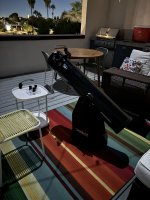

That is only (1) full moon in a cloudless sky with perfect seeing, (2) Phoenix ambient light pollution (Bortle 8), at 11pm.
8" reflector (1200), 20mm Tele Vue Plossl eyepiece, no filter. It appears as a curly bracket with a dot in the center just "above" (inverted) the equatorial belt. No color resolves in my scope for Jupiter except a faint, general tan for features against white-yellow.
The GRS has been growing fainter and indeed the storm may be ending, or at least dropping below the atmospheric surface, after at least 300 years of direct human observation. I am so glad to have seen it!
I lack the photographic equipment to capture anything like that detail yet. Indeed I had never seen it until I got my first "quality" eyepiece ($140 instead of my usual $40).
Perfect seeing tonight. Spectacularly bright full moon. This is no artificial lighting of any kind and no flash:
That is only (1) full moon in a cloudless sky with perfect seeing, (2) Phoenix ambient light pollution (Bortle 8), at 11pm.
Last edited:

Kepler
Si certus es dubita
Nancy Grace Roman was a helluva person.
Launch for late 26 through mid 27.
The missions:
Launch for late 26 through mid 27.
The missions:
Using the Wide Field Instrument, Roman will conduct three core surveys which will account for 75% of the primary mission. The High-Latitude Wide-Area Survey will combine the powers of imaging and spectroscopy to unveil more than a billion galaxies strewn across a wide swath of space and time. Astronomers will trace the evolution of the universe to probe dark matter — invisible matter detectable only by how its gravity affects things we can see — and trace the formation of galaxies and galaxy clusters over time.
The High-Latitude Time-Domain Survey will probe our dynamic universe by observing the same region of the cosmos repeatedly. Stitching these observations together to create movies will allow scientists to study how celestial objects and phenomena change over time periods of days to years. That will help astronomers study dark energy — the mysterious cosmic pressure thought to accelerate the universe’s expansion — and could even uncover entirely new phenomena that we don’t yet know to look for.
Roman’s Galactic Bulge Time-Domain Survey will look inward to provide one of the deepest views ever of the heart of our Milky Way galaxy. Astronomers will watch hundreds of millions of stars in search of microlensing signals — gravitational boosts of a background star’s light caused by the gravity of an intervening object. While astronomers have mainly discovered star-hugging worlds, Roman’s microlensing observations can find planets in the habitable zone of their star and farther out, including worlds like every planet in our solar system except Mercury. Microlensing will also reveal rogue planets—worlds that roam the galaxy untethered to a star — and isolated black holes. The same dataset will reveal 100,000 worlds that transit, or pass in front of, their host stars.
The remaining 25% of Roman’s five-year primary mission will be dedicated to other observations that will be determined with input from the broader scientific community. The first such program, called the Galactic Plane Survey, has already been selected.
Because Roman’s observations will enable such a wide range of science, the mission will have a General Investigator Program designed to support astronomers to reveal scientific discoveries using Roman data. As part of NASA’s commitment to Gold Standard Science, NASA will make all of Roman’s data publicly available with no exclusive use period. This ensures multiple scientists and teams can use data at the same time, which is important since every Roman observation will address a wealth of science cases.
Kepler
Si certus es dubita
Check out this neat astrophysics resource. It is written at a layman's level and useful for definitions.
Kepler
Si certus es dubita
I kinda sorta knew that Castor and Pollux of Gemini were mixed up with the house of Atreus myth. But man I didn't know the deets. The Greeks are a trip:
So, not astronomy, but how come all these poor cats had angered the gods so much they had that hard a row to hoe? Welp:
The story of the Greek god Zeus adopting the form of a swan and visiting (editor's note: this is code for "rape") the woman Leda and coupling with her is well-known. What is also fairly well-known to fans of classical myth is that this union between Leda and swan-shaped Zeus resulted in Leda conceiving a child, who became Helen of Troy. W. B. Yeats treats this myth, and the dramatic ramifications of it resulting in the Trojan War, in his sonnet, ‘Leda and the Swan’. (editor's note: go to the link, it's the most hardcore bitter poem I have ever read)
But what is less well-known is that Zeus and Leda’s union resulted in the conception of another child, a boy who was named Pollux. (He was actually known as Polydeuces to the Greeks, but we almost always refer to him now by his Latin name, Pollux.)
But there’s more. On the same night that Leda conceived Helen and Pollux with Zeus/the swan, she also lay with her husband, King Tyndareus of Sparta, and conceived twins with him as well. These twins were named Castor and Clytemnestra.
Both Helen and Clytemnestra would play important roles in the legends surrounding the Trojan War. But the focus of this summary and analysis is, of course, the two boys: Castor and Pollux. What became of them?
These two twins were known collectively as the Dioscuri, meaning ‘sons of Zeus’. Of course, this is only partly true, since Castor was actually the (mortal) son of Tyndareus, at least in many versions of the myth. But the two young men were inseparable and were both famed in their home city of Sparta for their skill and bravery. They were both known for their skill as fighters, with Pollux being especially renowned for his skilful boxing.
One day, their sister, Helen – later to become known as Helen of Troy – was kidnapped. No, not by Paris, the Trojan prince (that was to come later), but by Theseus, the hero who slew the Minotaur in the Labyrinth. Theseus imprisoned Helen in a fortress and then went to the Underworld to ask for Persephone’s hand in marriage. While he was absent, Castor and Pollux seized their chance – and their sister.
Once they had set Helen free, their usurped Theseus’ son, who was minding the throne of Attica in his father’s absence, and put another man in charge of the kingdom. They then kidnapped Theseus’ mother, Aethra, and took her back to Sparta with them.
This story illustrates both how brave and resourceful the twins were, but also how close they were, capable of working together to achieve a common aim. Such characteristics are also present in their other adventures, such as when, in the story of Jason and the Golden Fleece, they saved the ship, the Argo, from a storm.
Their other most famous adventure, however, involves their part in the battle of Lake Regillus, in which they fought alongside the newly established Roman Republic against their enemies, the Latin League.
When Castor died, Zeus gathered Pollux up into heaven so the two brothers could be together. But Pollux didn’t want to be apart from his twin. Zeus, understanding this, decreed that for half the year – on every other day – the two brothers would be together with the gods up in heaven. They became the constellation Gemini – ‘the twins’.
So, not astronomy, but how come all these poor cats had angered the gods so much they had that hard a row to hoe? Welp:
Previously:
Pelops and Hippodamia had many sons; two of them were Atreus and Thyestes. Depending on myth versions, they murdered Chrysippus, who was their half-brother. Because of the murder, Hippodamia, Atreus, and Thyestes were banished to Mycenae, where Hippodamia is said to have hanged herself.
Atreus vowed to sacrifice his best lamb to Artemis. Upon searching his flock, however, Atreus discovered a golden lamb which he gave to his wife, Aerope, to hide from the goddess. She gave it to Thyestes, her lover and Atreus' brother, who then persuaded Atreus to agree that whoever had the lamb should be king. Thyestes produced the lamb and claimed the throne.
Atreus retook the throne using advice he received from Zeus, who sent Hermes to him, advising him to make Thyestes agree that if the sun rose in the west and set in the east, the throne of the kingdom should be given back to Atreus. Thyestes agreed, but then Helios did exactly that, rising where he usually set and setting where he usually rose, not standing the injustice of Thyestes' usurpation.
Atreus then learned of Thyestes' and Aerope's adultery and plotted revenge. He killed Thyestes' sons and cooked them, save their hands and feet. He tricked Thyestes into eating the flesh of his own sons and then taunted him with their hands and feet. Thyestes was forced into exile for eating human flesh. Thyestes responded by asking an oracle what to do, who advised him to have a son by his daughter, Pelopia, who would then kill Atreus. However, when their son Aegisthus was first born, he was abandoned by his mother, who was ashamed of the incestuous act. A shepherd found the infant Aegisthus and gave him to Atreus, who raised him as his own son. Only as he entered adulthood did Thyestes reveal the truth to Aegisthus, that he was both father and grandfather to the boy. Aegisthus then killed Atreus, although not before Atreus and Aerope had two sons, Agamemnon and Menelaus, and a daughter Anaxibia.
Agamemnon married Clytemnestra, and Menelaus married Helen, her famously attractive sister. Helen later left Sparta with Paris of Troy, and Menelaus called on all of his wife's former suitors to help him take her back.
Prior to sailing off to war against Troy, Agamemnon had angered the goddess Artemis because he had killed a sacred deer in a sacred grove, and had then boasted that he was a better hunter than she was. (editor's note: Jesus fuck. You deserve what's coming, my Brother in Zeus) When the time came, Artemis stilled the winds so that Agamemnon's fleet could not sail. A prophet named Calchas told him that in order to appease Artemis, Agamemnon would have to sacrifice the most precious thing that had come to his possession in the year he killed the sacred deer. This was his first-born daughter, Iphigenia. He sent word home for her to come (in some versions of the story on the pretense that she was to be married to Achilles). Iphigenia accepted her father's choice and was honored to be a part of the war. Clytemnestra tried to stop Iphigenia but was sent away. After doing the deed, Agamemnon's fleet was able to get under way.
While he was fighting the Trojans, his wife Clytemnestra, enraged by the murder of her daughter, began an affair with Aegisthus. When Agamemnon returned home he brought with him a new concubine, the doomed prophetess, Cassandra. Upon his arrival that evening, before the great banquet she had prepared, Clytemnestra drew a bath for him and when he came out of the bath, she put the royal purple robe on him which had no opening for his head. He was confused and tangled up. Clytemnestra then stabbed him to death.
Agamemnon's only son, Orestes, was quite young when his mother killed his father. He was sent into exile. In some versions he was sent away by Clytemnestra to avoid having him present during the murder of Agamemnon; in others his sister Electra herself rescued the infant Orestes and sent him away to protect him from their mother. In both versions he was the legitimate heir apparent and as such a potential danger to his usurper uncle.
Goaded by his sister Electra, Orestes swore revenge. He knew it was his duty to avenge his father's death, but saw also that in doing so he would have to kill his mother. He was torn between avenging his father and sparing his mother. 'It was a son's duty to kill his father's murderers, a duty that came before all others. But a son who killed his mother was abhorrent to gods and to men'.
When he prayed to Apollo, the god advised him to kill his mother. Orestes realized that he must work out the curse on his house, exact vengeance and pay with his own ruin. After Orestes murdered Clytemnestra and her lover Aegisthus, he wandered the land with guilt in his heart. After many years, with Apollo by his side, he pleaded to Athena. No descendant of Atreus had ever done so noble an act and 'neither he nor any descendant of his would ever again be driven into evil by the irresistible power of the past.' Thus Orestes ended the curse of the House of Atreus.
Last edited:
